"Dispersive shock waves in the discrete nonlinear Schrödinger equation"
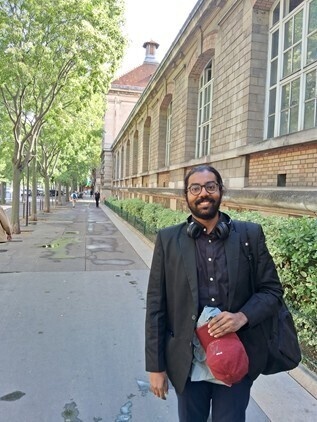
Sathya Chandramouli
University of Massachusetts Amherst
Wednesday, Jan 28, 2026
- Colloquium - 499 DSL Seminar Room
- 03:30 to 04:30 PM Eastern Time (US and Canada)
Abstract:
In conservative media, the dispersive regularization of gradient catastrophe gives rise to dispersive shock waves (DSWs). Unlike classical viscous shocks, a DSW is a highly oscillatory nonlinear wavetrain whose leading edge propagates faster than the long-wave speed, while the entire structure expands over time. A powerful framework for describing DSWs is Whitham modulation theory (WMT), a nonlinear WKB-type approach that captures the slow evolution of wave parameters such as amplitude, wavelength, and frequency.
In this talk, we study DSWs in the one-dimensional discrete, defocusing nonlinear Schrödinger equation (DNLS), with a particular focus on strongly discrete regimes approaching the anti-continuum limit (ACL), as well as intermediate regimes bridging the ACL and the continuum limit. Using WMT in combination with asymptotic reductions, we analyze the long-time evolution of step initial data and elucidate how lattice-induced dispersion alters shock structure. Our analysis reveals a sharp discretization threshold beyond which continuum DSW dynamics are recovered, as well as a rich variety of intermediate shock morphologies unique to the discrete setting. Finally, we apply these results to shock wave formation in ultracold atomic gases confined in optical lattices, within the framework of the tight-binding approximation.
| File | Description | File size |
|---|---|---|
 e8f0c9efb99f4004b214e9856d3ceedc083c7813.jpg e8f0c9efb99f4004b214e9856d3ceedc083c7813.jpg | Headshot | 59 kB |