"Conservative cell-average-based neural network method for nonlinear conservation laws"
Jue Yan
Department of Mathematics
Iowa State University
Wednesday, Apr 1, 2026
- Colloquium - 499 DSL Seminar Room
- 03:30 to 04:30 PM Eastern Time (US and Canada)
Abstract:
In this talk, we present the recently developed Cell-Average-Based Neural Network (CANN) for time-dependent PDEs. Spatial and temporal discretization in conventional methods is replaced by training a simple feedforward network to obtain an explicit one-step finite volume method. The well-trained network parameters function as the scheme coefficients. The network method has a minimum number of unknowns, which can be quickly trained on a small training dataset. Unlike conventional numerical methods, the CANN approach is not limited by the CFL conditions, enabling the use of significantly larger time steps. This leads to a highly efficient computational method for solving PDEs. The conservative version of the CANN method for nonlinear conservation laws will be discussed. The method, trained on the smooth-solution data from ONE initial-value problem, is verified to solve any initial-value problem involving shocks and rarefaction waves. The network can accurately learn a numerical flux, such as the Lax-Friedrichs flux, thereby guaranteeing convergence to the physically relevant entropy solutions. The extension of the method to non-uniform meshes will be considered. A bound-preserving version of the network method is presented for linear Advection equations.
| File | Description | File size |
|---|---|---|
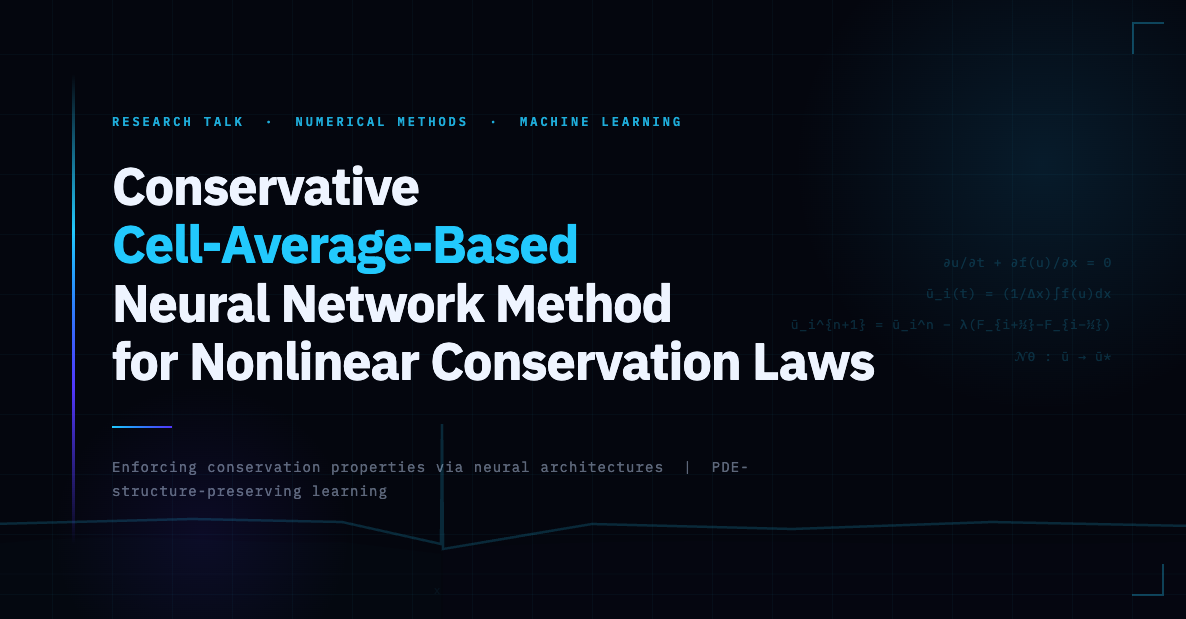
 Screenshot 2026-03-29 at 1.10.10 PM.png Screenshot 2026-03-29 at 1.10.10 PM.png | AI generated research image | 269 kB |