"Predictive Design and Control of Fusion Pilot Plant Burning Plasmas"
Tomasz Plewa
Professor
Department of Scientific Computing
Florida State University
Wednesday, Apr 22, 2026
- Colloquium - 499 DSL Seminar Room
- 03:30 to 04:30 PM Eastern Time (US and Canada)
Abstract:
Fusion energy is clean, safe, and effectively limitless. This project builds the computational foundation needed to make it practical — connecting rigorous physics, NIF experimental data, and modern AI into a single learning system that grows smarter as the plant operates.
A fusion pilot plant must fire a tiny hydrogen fuel capsule millions of times a year. Each shot must release more energy than it consumes. No human operator can adjust thousands of variables fast enough between shots. The plant needs to learn, adapt, and run itself.
We are building a digital twin of a fusion pilot plant burning core. A digital twin is a virtual replica that mirrors the real system in real time. It learns from data. It predicts what comes next. Eventually it controls the plant — shot by shot — without human intervention.
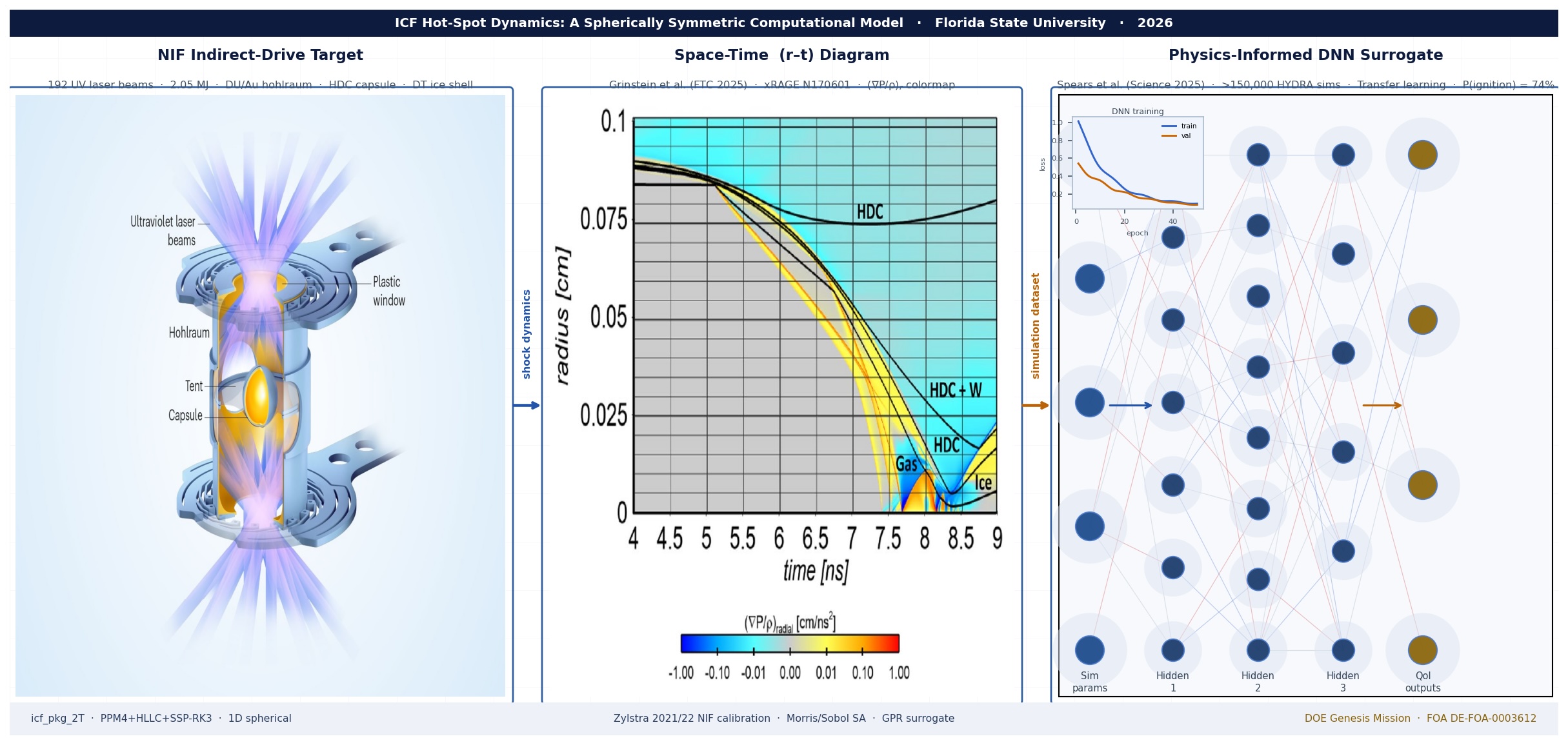
The first step is understanding what happens inside the burning plasma. We have built a fast physics model of the hot compressed core — the hot spot — that forms at the moment of fusion. The model runs in seconds. We have tested it carefully against known solutions, then tuned it to match real NIF experiments — the world's most powerful laser fusion facility. It correctly reproduces when ignition occurs, how hot and dense the plasma gets, and how much fuel is consumed.
We are using this model to generate large datasets of simulated shots. A machine learning surrogate will be trained on these datasets. The surrogate will be thousands of times faster than the physics model. It will be embedded in the plant control system. After each real shot, the system reads the diagnostics, updates its picture of the plasma, and sets the conditions for the next shot — autonomously.
| File | Description | File size |
|---|---|---|
 Plewa_colloquium_annoucement_visual.jpg Plewa_colloquium_annoucement_visual.jpg | Research Image | 521 kB |