"PGINN -- Population Genetics Informed Neural Networks"
Peter Beerli
Department of Scientific Computing,
Florida State University (FSU)
Wednesday, Nov 4, 2026 
- Colloquium - 499 DSL Seminar Room
- 03:30 to 04:30 PM Eastern Time (US and Canada)
Abstract:
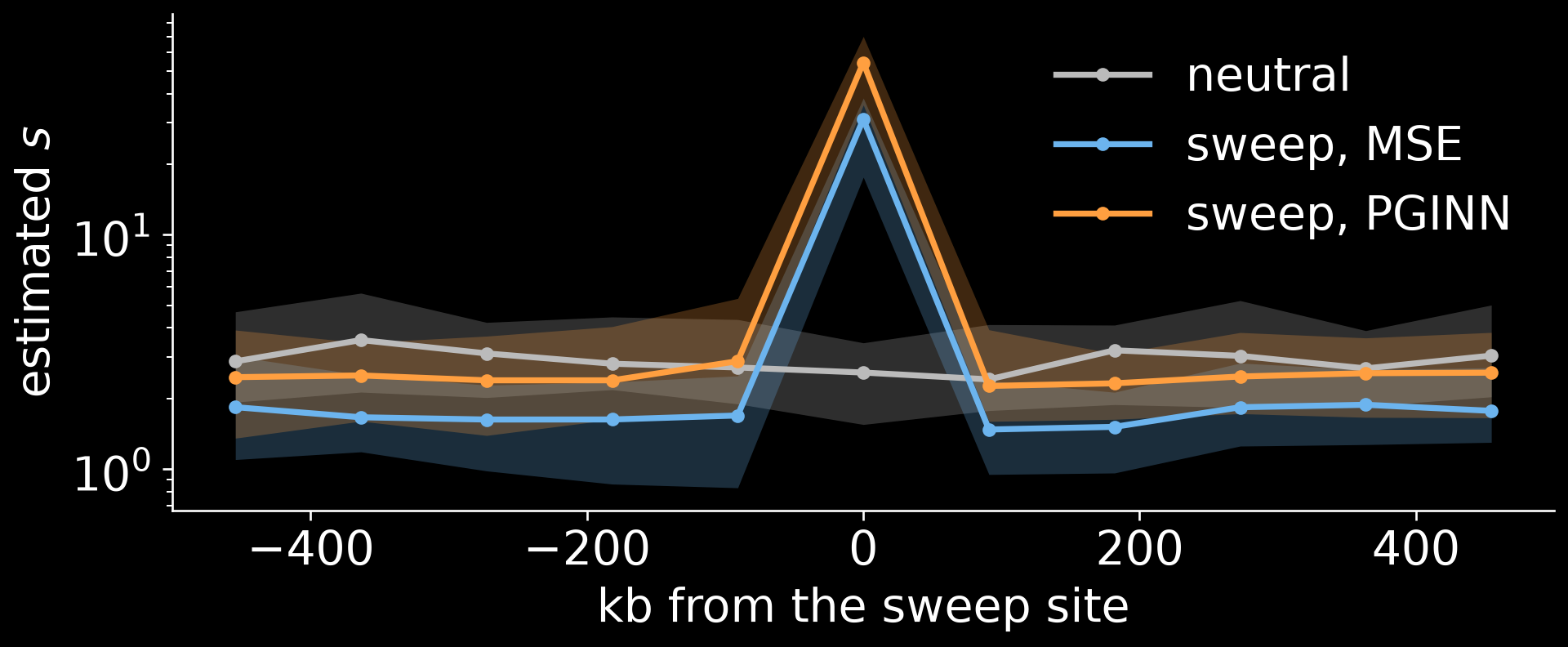
Neural networks trained on simulated genealogies estimate population-genetic parameters quickly, but their loss ignores the model that generated the data. Following physics-informed neural networks, we introduce PGINN (Population-Genetics-Informed Neural Networks), which add to the loss a term built from the coalescent rate along each genealogy. We study one population under a completed hard sweep, with 10 independent data sets per comparison. With log-scaled input, the local rate divergence improves the estimate of the population-scaled selection coefficient s in every regime: it removes 7 to 12% of the squared error in log(1+s) of a network trained without it. Penalties exact for the coalescent process give little gain. The local rate divergence helps through its asymmetry: it penalizes an underestimate of strong selection and counters the shrinkage of networks trained with mean squared error (MSE). With known genealogies, maximum likelihood is more accurate still. The gain carries over to genealogies estimated by the software MIGRATE from simulated recombining chromosomes: networks with the local rate divergence detect sweeps with s=50 to 200 more often than MSE in 9 of 10 training runs, and both detect weak sweeps more than twice as often as a scan for low Θ. At the Adh locus of Drosophila melanogaster, estimates of s are consistent with neutrality. The penalty needs only coalescent rates, so changing population size, structure or migration can be handled the same way. Where likelihood methods are unavailable or too slow, PGINN offers a simple way to bring population-genetic theory into network training.
| File | Description | File size |
|---|---|---|
 flyer_graph.png | Research | 126 kB |