"Riding with Fuel: How Supernova Flames Preheat Their Surroundings"
Tomasz Plewa
Department of Scientific Computing,
Florida State University (FSU)
Wednesday, Oct 21, 2026 
- Colloquium - 499 DSL Seminar Room
- 03:30 to 04:30 PM Eastern Time (US and Canada)

Click Here to Join via Zoom
Meeting # 942 7359 5552
Zoom Meeting # 942 7359 5552
Abstract:
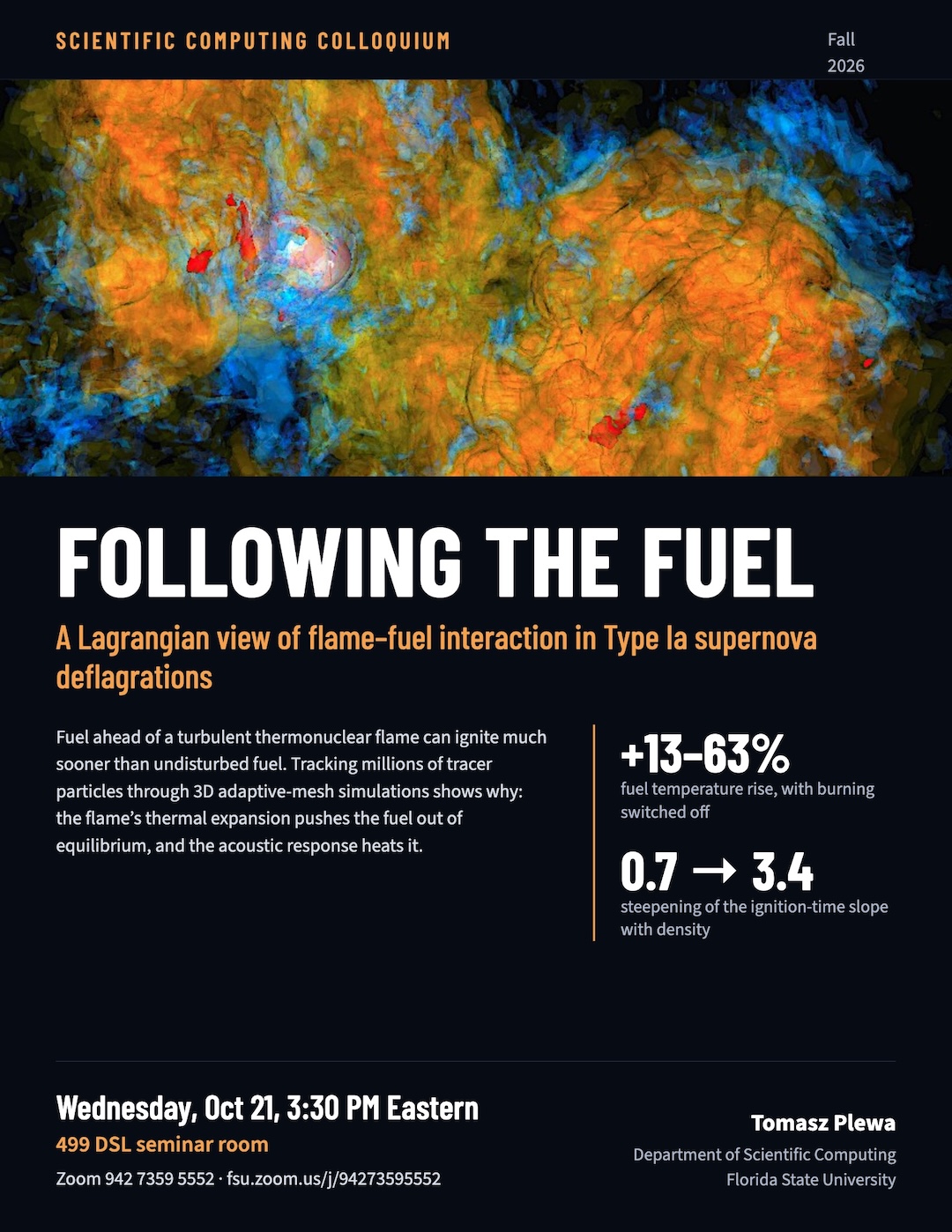
Type Ia supernovae are thermonuclear explosions of white dwarfs. In the leading scenario, the explosion begins with a subsonic flame, or deflagration, whose buoyant rise drives turbulent motion and increasingly fine structure. Earlier simulations found a surprising effect: fuel ahead of the flame can become much quicker to ignite than undisturbed fuel. This preconditioning may matter for whether a deflagration can later transition to a detonation, but its physical origin was unclear.
We investigate this effect by tracking millions of Lagrangian tracer particles through three-dimensional adaptive-mesh simulations at three fuel densities. The particle histories let us follow the thermodynamic changes experienced by individual parcels as they approach the flame. We find that ignition time decreases as a power law of distance from the flame, with the fitted exponent steepening from about 0.7 at the lowest density to 3.4 at the highest. The reduction is accounted for almost entirely by fuel-temperature increases of 13–63% relative to unperturbed fuel.
We propose a two-step mechanism: thermal expansion of the flame first drives nearby fuel away from hydrostatic equilibrium. The fuel’s subsequent pressure adjustment, mediated by acoustic waves, redistributes internal energy toward the thermal component and raises its temperature. Because nuclear burning is disabled in these simulations, they establish neither secondary ignition nor detonation. Burning-enabled simulations are the next step toward testing whether this preconditioning can help trigger either outcome.
| File | Description | File size |
|---|---|---|
 snia_fuel_graphics_2026-10-21.jpg | Research | 417 kB |