Headlines
Contact DSC Public Relations
Department of Scientific Computing student Yifan Wang has been accepted to participate in COGNESTIC 2026, an international training program hosted by the Cognition and Brain Sciences Unit that brings together early-career researchers working at the intersection of neuroscience, cognition, and computational methods. The program will take place this September and provides selected participants with intensive workshops, lectures from leading scientists, and collaborative research opportunities.
- Details
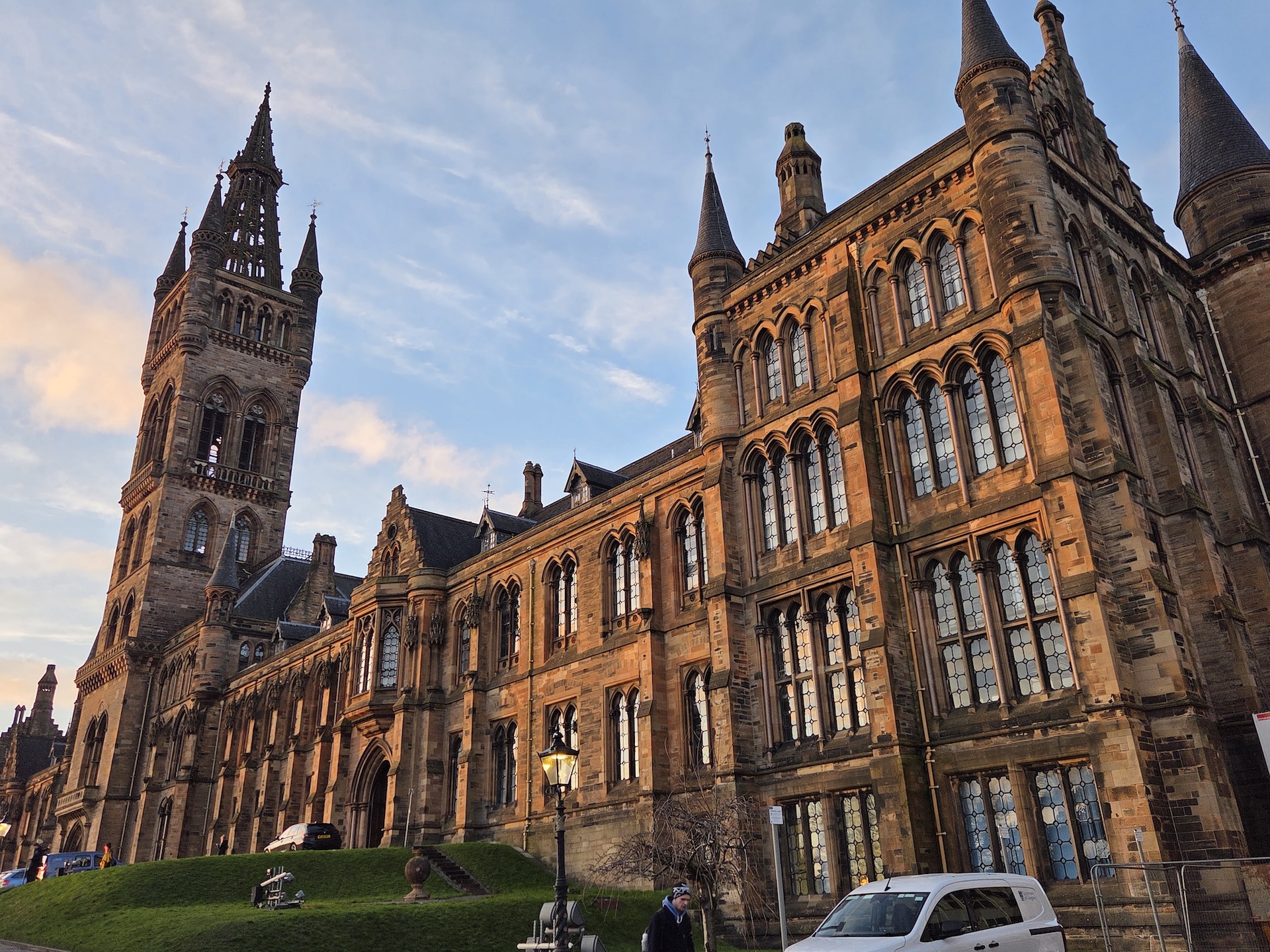
Ocean Sciences 2026 - University of Glasgow's main building
Students Jose Miranda and Jorge Velasco represented Florida State University's Department of Scientific Computing and the Center for Ocean-Atmospheric Prediction Studies (COAPS) at the 2026 Ocean Sciences Meeting held in Glasgow, Scotland this past February, presenting innovative research that applies machine learning to advance oceanographic observation and analysis.
- Details
A research team in the Department of Scientific Computing has expanded a 1950s math game and turned it into a project that helps undergraduate students practice and grow their skills.
Bryan Quaife, associate professor in the Department of Scientific Computing and faculty associate of the Geophysical Fluid Dynamics Institute, based the work on Martin Gardner’s 1957 puzzle “Four Bugs on a Square.” In the original problem, one bug starts at each corner of an imaginary square and moves toward the one ahead of it at the same speed. Their paths form matching spirals that curve inward until they meet at a single point.
- Details
Anke Meyer-Baese, a professor in the Department of Scientific Computing in the College of Arts and Sciences, received the John von Neumann Distinguished Award in STEM, a Fulbright Distinguished Scholar Award, to conduct cutting-edge STEM research at the University of Szeged in Szeged, Hungary.
Meyer-Baese will spend the spring 2026 semester developing new research that combines artificial intelligence (AI) and modern control network theory to study the spread of neurodegenerative conditions like Alzheimer’s disease. In addition, she will be teaching a course on AI with the University’s Research Group on Artificial Intelligence (RGAI). The University of Szeged is a premier AI center in Europe, so being able to work at this location will deepen her understanding of theoretical foundations in AI.
- Details
We are proud to announce that our PhD student, Jorge Eduardo Velasco Zavala, has been accepted and awarded a travel grant to attend the HPC4Climate Summer School 2025. The event will be held from 28 July to 7 August 2025 at DJH Jugendherberge Lauenburg in Lauenburg, Germany.
- Details
Florida State University
400 Dirac Science Library
Tallahassee, FL 32306-4120
admin@sc.fsu.edu
© Scientific Computing, Florida State University